AprilAire E100 Whole-House Dehumidifier: Specification Guide
Quick answer: Treat the E100 as an HVAC component whose performance depends on airflow, duct layout, controls and commissioning.
As an Amazon Associate, we may earn from qualifying purchases.
Compare LDHTHOPI 145 Pint Commercial Dehumidifier on Amazon
Treat the E100 name as a starting point
An E100 evaluation should be tied to the current product data and installation manual available for the exact unit being sold. Confirm the full model designation, document revision, seller, included controls or accessories, and selected variation. Record the published removal capacity together with its temperature and relative-humidity test condition; a number without its condition cannot predict a specific house. Also capture airflow, allowed external static pressure, voltage, current, operating-temperature range, cabinet dimensions, weight, collar details, drain connection, filter part, and approved orientations. Do not fill missing specifications from a different AprilAire model or an older E100 document. If the unit is listed on Amazon, confirm that the chosen variation and ASIN correspond to the cabinet analyzed here, then verify all installation facts from current manufacturer material before ordering.
Decide whether E100-class capacity fits the house
The model should be evaluated against measured humidity by floor, outdoor dew point, ventilation, cooling-system behavior, infiltration, occupancy, and any crawl-space or basement contribution. Correct bulk leaks and obvious duct or drainage defects first. Estimate whether the project needs maintenance control under normal weather, faster recovery after high-humidity events, or both. Compare the E100’s documented performance at conditions resembling the proposed return air, not merely its headline rating. Review electrical and airflow consequences alongside capacity. A model can be nominally large enough yet fail because it cannot move air through the chosen ducts; it can also be unnecessarily large for an isolated small load. Record the assumptions and acceptance target so the installed result can be compared with the reason the E100 was selected.
Lay out the E100 air route on paper
Use a current E100 installation diagram that matches the intended relationship with the HVAC system. Mark intake, discharge, central return, central supply, air-handler blower, zoning dampers, backdraft control if specified, and representative sensor location. Add duct lengths, diameters, elbows, transitions, grilles, and filters, then have the installer check predicted external static against the published limit. Provide separation between intake and dry-air discharge to prevent short circuiting. Consider how closed bedroom doors and multiple floors obtain a return path. If the E100 is expected to operate while the air conditioner is off, verify how dry air is distributed and whether the air-handler blower runs. The aim is not simply to connect both collars; it is to create a defined circuit through the humid living space without pushing against an unsupported or closed path.
Verify orientation, clearance, and filter removal
Before purchase, make a scaled outline or cardboard footprint of the cabinet and collars in the proposed location. Include the filter’s complete withdrawal path and the space needed to remove every service panel, reach wiring, inspect the condensate connection, and clean the drain. Confirm the E100’s allowed orientation and support requirements from the current manual. Check the delivery path through attic openings, stairs, doors, and turns. An attic or crawl installation must also stay within the documented environmental range and provide safe technician access, lighting, and a stable work surface. Consider vibration and duct-borne sound near sleeping areas. If the design places the unit above finished space, include drainage safeguards appropriate to the manufacturer instructions and local requirements. Reject a compact-looking placement if routine maintenance would require dismantling ductwork or moving the cabinet.
Specify E100 condensate and electrical work
Draw the drain from the cabinet connection to its approved receptor. For gravity, show required slope, support, trap or vent details where specified, freeze exposure, cleanout, and termination. For a pump, document tubing, vertical lift, horizontal route, fittings, power, safety interlock, and response to a full reservoir. Observe actual condensate during commissioning; pouring water somewhere in the system may not test normal collection or every connection. Separately, use the E100 nameplate and current manual to define voltage, current, circuit, disconnect, grounding, and permitted wiring. Ask how the unit and air handler respond after a power interruption. Qualified trades should complete work within local requirements. Label the circuit and drain so future service does not depend on memory or an undocumented installer shortcut.
Document control wiring and operating sequence
Identify the exact controller or interface included and verify its compatibility with the E100 and the home’s HVAC equipment. The sequence should state what initiates a humidity call, whether the central blower is energized, which dampers open, what ventilation does, and what terminates operation. Account for simultaneous cooling and dehumidification. Locate the sensing point where it represents living conditions, not discharge air or an extreme mechanical space. If a remote or connected control is used, test local operation and clarify what continues without network access. Record the initial setpoint and avoid using an unnecessarily low target to compensate for poor sensor location. Label terminals and preserve the wiring diagram. Control errors can make a mechanically sound E100 appear undersized or can cause excessive blower and compressor runtime.
Commission this exact E100 installation
Commissioning should connect the specification review to measured operation. Record serial number, manual revision, orientation, filter, duct layout, control and wiring, setpoint, drain route, and baseline readings. Measure or verify airflow and external static by the method the design calls for. Observe blower interaction, air temperatures, sound, vibration, condensate, pump or overflow safety, and restart behavior. Place independent sensors on different levels and in the historically humid zone, away from outlets. Trend them through several days and humid weather rather than declaring success after one cycle. If results differ from the target, check source loads, return paths, dampers, filters, duct leakage, sensor placement, drain faults, and HVAC sequence before concluding that the E100 lacks capacity. Give the owner the exact filter, cleaning interval, warranty registration, and service contact.
Products to compare for this decision
The products below are exact Amazon catalog records selected for this topic. We have not hands-on tested every machine. Confirm the current variation, seller, capacity conditions, electrical requirements, drainage configuration, warranty and availability before buying.
As an Amazon Associate, we may earn from qualifying purchases.
 B0GGZDLMM2
LDHTHOPI 145 Pint Commercial Dehumidifier
145-pint class; drain hose; automatic defrost. Verify every listed specification and variation on Amazon before ordering.
Check on Amazon B0FWB57KYQ
AEOCKY 8000-Square-Foot Commercial Dehumidifier
large-space listing; Energy Star claim; verify rated condition. Verify every listed specification and variation on Amazon before ordering.
Check on Amazon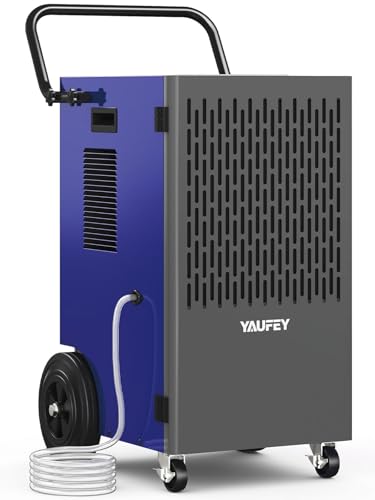 B0CN6ZST2Q
Yaufey 155 Pint Commercial Dehumidifier With Pump
155-pint class; pump; humidity control. Verify every listed specification and variation on Amazon before ordering.
Check on AmazonFrequently asked questions
Is the AprilAire E100 suitable for every 3,000-square-foot house?
No. Equal floor areas can have very different climate, leakage, ventilation, occupancy, layout, and source moisture. Use measured conditions and a load-based design rather than a universal area threshold.
Can the E100 be installed in an attic or crawl space?
Only when the current manual permits the orientation and environmental conditions and the design provides safe support, power, drainage, clearances, and service access.
Does the E100 require the HVAC blower?
That depends on the approved duct arrangement and control sequence. The contractor should identify the exact diagram and explain operation during independent humidity and cooling calls.
What should be verified before ordering online?
Confirm exact model and variation, current official specifications, required accessories and controls, duct and service fit, electrical supply, drainage, warranty eligibility, installer, and return implications.
Final verdict
The AprilAire E100 should be chosen only when its current documented capacity, airflow, static limit, physical arrangement, controls, power, and drainage fit a measured house problem. The model name is not the design. A successful E100 project is the exact cabinet installed to an approved air path and then commissioned across the living space with a clear maintenance and service record.
Continue the research
What Affects the Cost to Install a Crawl-Space Dehumidifier?
The machine is only one line item; encapsulation, drainage, electrical work, ducting and access often determine installed cost.
Open guide →How to Install a Crawl-Space Dehumidifier: Planning Before the Work
A safe plan follows the exact manual and local requirements rather than a universal set of internet measurements.
Open guide →Who Installs Crawl-Space Dehumidifiers?
The right contractor depends on whether the project needs moisture diagnosis, encapsulation, drainage, electrical work, HVAC ducting or all five.
Open guide →What Size Dehumidifier Does a Crawl Space Need?
Size from volume and moisture load, then check capacity at the crawl space’s temperature—not at a warmer marketing condition.
Open guide →Use the commercial sizing calculator or return to the commercial dehumidifier guide.