How to Identify the Best Crawl-Space Dehumidifier for Your House
Quick answer: The best choice is the documented fit for the space, drain, climate and service plan—not the model with the biggest coverage claim.
As an Amazon Associate, we may earn from qualifying purchases.
Compare Yaufey 70 Pint Energy Star Commercial Dehumidifier on Amazon
Best means best matched
There is no universal winner. The strongest model is the one whose documented operating range, actual-condition capacity, airflow, drainage and service plan fit a specific crawl space. Create a worksheet with area, height, temperature, humidity, layout, ground cover, vents, water history, circuit and drain. Eliminate products that cannot meet physical constraints before comparing conveniences.
Normalize every claim
Put pints per day beside the test condition and keep saturation and AHAM figures separate. Seek cool-condition data and defrost information. Coverage area is only a preliminary filter. Score airflow and approved ducting against walls and bays, because the largest removal figure has little value if dry air never reaches the remote end.
Make drainage a top criterion
Gravity is mechanically simple with reliable fall to an approved receptor. A pump helps with lift but adds a reservoir, switch and service need. Compare tubing, head, overflow response and replacement access. Test the route and determine what happens on blockage or outage. Continuous drain never means maintenance-free.
Weight ownership, not gadgets
Check hatch fit, cabinet balance, filter and panel access, coil and pan service, parts, warranty and qualified repair. Remote monitoring is secondary to performance and may depend on connectivity or subscriptions. Score documentation, drainage reliability, layout fit, power, serviceability and efficiency before Wi-Fi or marketing labels.
Validate the winner
Do not install around standing water, unsafe wiring, structural problems or contamination. After source control and installation, use independent sensors in several zones, confirm drainage and track humid-weather performance. Diagnose source, enclosure, circulation, filter, coil, drain and temperature before blaming capacity. Evidence after commissioning determines whether the recommendation was correct.
Field-specific planning notes
The best crawl-space dehumidifier is the one that fits the measured load and can be drained, powered, distributed, and maintained in the actual enclosure. Start by rejecting candidates that cannot pass through the access hatch or operate within the crawl's temperature range. Next compare removal ratings under the same test standard rather than mixing warm saturation numbers with more realistic conditions. Airflow matters where piers divide the space; optional duct collars can be more valuable than a larger headline capacity. Decide how condensate will leave. A gravity drain avoids pump maintenance but requires reliable fall, while an internal pump helps with elevation and introduces tubing, lift, and failure considerations. Look for reachable filters, clear service panels, documented defrost behavior, and controls that can sense representative air. Warranty length is less useful if service or replacement parts are difficult to obtain. Avoid treating an enormous coverage claim as proof of fit. A vented, bare-soil crawl with seepage can overwhelm equipment that would easily control a sealed, encapsulated space of the same area. Fix water and enclosure defects first, then size from temperature, volume, and remaining load. After installation, use multiple independent hygrometers and inspect after storms. Consistent conditions across remote bays are stronger evidence of success than the display on the cabinet. The best model is therefore a defensible system choice, not a universal winner.
The best model is therefore a defensible system choice, not a universal winner.. Consistent conditions across remote bays are stronger evidence of success than the display on the cabinet. After installation, use multiple independent hygrometers and inspect after storms. Fix water and enclosure defects first, then size from temperature, volume, and remaining load. A vented, bare-soil crawl with seepage can overwhelm equipment that would easily control a sealed, encapsulated space of the same area. Avoid treating an enormous coverage claim as proof of fit. Warranty length is less useful if service or replacement parts are difficult to obtain. Look for reachable filters, clear service panels, documented defrost behavior, and controls that can sense representative air. A gravity drain avoids pump maintenance but requires reliable fall, while an internal pump helps with elevation and introduces tubing, lift, and failure considerations. Decide how condensate will leave. Airflow matters where piers divide the space; optional duct collars can be more valuable than a larger headline capacity. Next compare removal ratings under the same test standard rather than mixing warm saturation numbers with more realistic conditions. Start by rejecting candidates that cannot pass through the access hatch or operate within the crawl's temperature range. The best crawl-space dehumidifier is the one that fits the measured load and can be drained, powered, distributed, and maintained in the actual enclosure
Products to compare for this decision
The products below are exact Amazon catalog records selected for this topic. We have not hands-on tested every machine. Confirm the current variation, seller, capacity conditions, electrical requirements, drainage configuration, warranty and availability before buying.
As an Amazon Associate, we may earn from qualifying purchases.
 B0FCS16H66
Yaufey 70 Pint Energy Star Commercial Dehumidifier
70-pint class; continuous drain; crawl-space positioning. Verify every listed specification and variation on Amazon before ordering.
Check on Amazon B08N6C4GPP
ALORAIR Sentinel HD55 Crawl-Space Dehumidifier
Sentinel HD55 model; low-profile cabinet; commercial positioning. Verify every listed specification and variation on Amazon before ordering.
Check on Amazon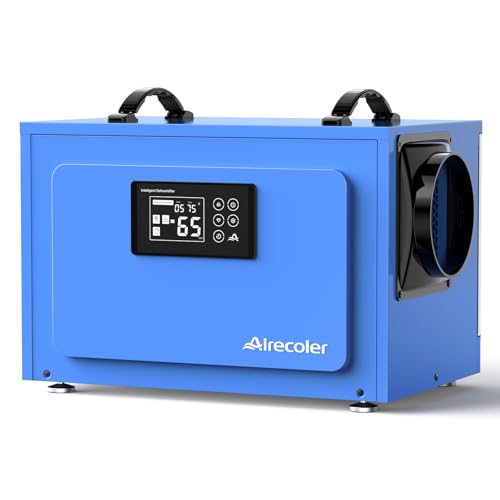 B0CVS5G92Z
Airecoler 125 Pint Commercial Crawl-Space Dehumidifier
125-pint class; crawl-space and basement positioning. Verify every listed specification and variation on Amazon before ordering.
Check on AmazonFrequently asked questions
Which brand is best?
Compare exact models and service, not brand alone.
Is a pump always better?
No; gravity is simpler when a safe falling route exists.
Is Wi-Fi necessary?
No. Performance, drainage, airflow and service come first.
Final verdict
The correct best crawl space dehumidifier decision follows documented site conditions rather than a headline coverage claim. Control water sources, compare exact performance at relevant conditions, design power and drainage, preserve service access, and validate the finished system with independent measurements.
Continue the research
Water-Damage Restoration Dehumidifiers: What to Compare
Restoration equipment is selected as part of a drying system that includes extraction, air movement, containment and measurement.
Open guide →Water-Restoration Dehumidifier Guide for Structural Drying
Track conditions and material moisture rather than running equipment for an arbitrary number of days.
Open guide →Choosing a Dehumidifier for Restoration Work
Portability, low-humidity performance, power sharing, hose management and field service matter alongside headline capacity.
Open guide →Flood-Restoration Dehumidifiers: Safe Planning After Water Loss
Address electrical, contamination and structural hazards before installing drying equipment.
Open guide →Use the commercial sizing calculator or return to the commercial dehumidifier guide.