Why CFM Matters on a Commercial Dehumidifier
Quick answer: Airflow affects mixing, duct capability and how quickly moist air reaches the coil; it does not replace removal capacity.
As an Amazon Associate, we may earn from qualifying purchases.
Compare AEOCKY 8000-Square-Foot Commercial Dehumidifier on Amazon
CFM describes air movement, not water removal
Cubic feet per minute indicates the volume of air a blower moves under stated conditions. It helps describe how quickly room air can reach the coil and whether dry air can be distributed through a space or duct. It does not tell how many pints the refrigeration system removes. Two machines with similar airflow can have different moisture performance, and two with similar pint ratings can distribute air differently.
Use CFM and removal capacity together. A high-capacity unit with poor distribution may dry the area beside it while remote materials stay wet. High airflow through a weak moisture-removal system may mix the room without achieving the target.
Estimate air changes carefully
A rough air-change rate can be calculated as CFM multiplied by 60 and divided by room volume in cubic feet. A 500-CFM unit in a 30,000-cubic-foot open zone produces a theoretical one air change per hour. This is not proof that every corner receives one exchange; shelving, partitions, leakage and short-circuit airflow reduce useful mixing.
Air changes also do not equal dehumidification cycles. Air leaving the machine mixes with building air, and moisture continues to enter from materials and outdoors. Use the calculation to compare distribution plans, not to promise drying time.
Free-air ratings change with duct resistance
Published CFM may be measured without attached ducts. Elbows, long flexible runs, small grilles and filters add external static pressure and reduce delivered flow unless the fan is designed to overcome it. For a ducted installation, find the manufacturer’s airflow table or fan curve at the proposed static pressure.
Do not assume adding a booster fan is harmless. It can alter coil airflow, condensate behavior and pressure relationships. Design ducts within approved lengths, diameters and configurations, and have an HVAC professional measure static pressure when the installation is substantial.
Distribution in open commercial spaces
Warehouses often have large cubic volume, high racks and intermittent door infiltration. Position the unit so inlet air represents the damp zone and discharge can travel without immediately returning. Supplemental air movers may help break stagnant layers, but their placement should encourage a broad circulation loop rather than blast dry air into the intake.
Measure at multiple elevations and distant locations. Warm dry air may stratify near the ceiling while slab-level inventory remains exposed. Door schedules and rack aisles can create separate microclimates that a single advertised coverage number misses.
CFM in restoration drying
A dehumidifier processes air to remove vapor; restoration air movers increase evaporation from wet materials. They serve related but different roles. Increasing evaporation without adequate dehumidification can raise ambient humidity and slow drying. Excessive or poorly directed airflow can also spread contaminants when containment is required.
Use a drying plan based on the water loss, affected materials, containment and measured progress. Track temperature, RH, humidity ratio when appropriate and material readings. Equipment counts based only on room square footage ignore the actual wet load.
Noise, filtration and fan energy
More airflow often brings more fan noise, draft and power consumption. Occupied offices, hospitality areas and public spaces may value lower fan speed or remote ducting. Confirm sound data at a stated distance and mode; a single decibel figure without context is hard to compare.
Filters protect the coil but introduce resistance, especially when dirty. Use approved media and inspect it according to exposure. An aftermarket high-efficiency filter may reduce airflow beyond the fan’s design. Evaluate filtration needs separately rather than turning the dehumidifier into an unapproved air cleaner.
How to compare CFM between models
Record maximum and selectable airflow, the condition of the rating, duct connections and allowed static pressure. Note whether the fan continues between compressor cycles. Then compare the room’s shape, circulation barriers and noise limits. A variable-speed machine may offer better balancing than a larger fixed fan.
After installation, verify the outcome rather than assuming catalog airflow reaches the whole zone. Check remote humidity trends, look for short-circuit paths and have delivered airflow measured when duct performance matters. The best number is the one the installed system can use.
Avoid using airflow as a drying-time promise
Dividing room volume by fan CFM produces a theoretical turnover time, but it does not predict how fast wood, concrete or inventory releases water. Evaporation depends on surface conditions, temperature, vapor-pressure difference and boundary-layer airflow. The dehumidifier must then remove the added vapor. Either side can become the limiting step.
For a wet structure, coordinate dehumidifier airflow with separate air movers and containment rather than treating the cabinet’s CFM as the whole drying system. For normal facility control, use remote RH trends to find stagnant areas. If adding circulation improves those areas without raising overall humidity, distribution was likely limiting; if the entire zone remains high, removal capacity or incoming load needs attention.
Products to compare for this decision
The products below are exact Amazon catalog records selected for this topic. We have not hands-on tested every machine. Confirm the current variation, seller, capacity conditions, electrical requirements, drainage configuration, warranty and availability before buying.
As an Amazon Associate, we may earn from qualifying purchases.
 B0FWB57KYQ
AEOCKY 8000-Square-Foot Commercial Dehumidifier
large-space listing; Energy Star claim; verify rated condition. Verify every listed specification and variation on Amazon before ordering.
Check on Amazon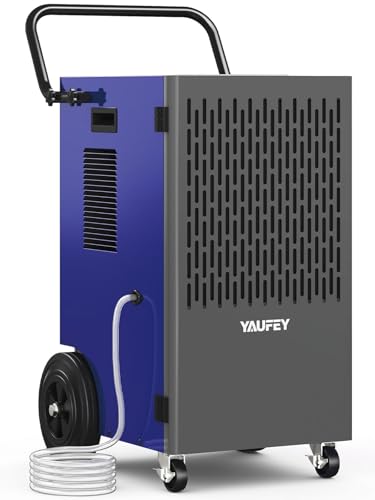 B0CN6ZST2Q
Yaufey 155 Pint Commercial Dehumidifier With Pump
155-pint class; pump; humidity control. Verify every listed specification and variation on Amazon before ordering.
Check on Amazon B0D1R9C6B8
Waykar 150 Pint Commercial Dehumidifier With Pump
150-pint class; built-in pump; basement positioning. Verify every listed specification and variation on Amazon before ordering.
Check on AmazonFrequently asked questions
Does higher CFM mean a better dehumidifier?
No. Higher CFM may improve mixing, but moisture removal, efficiency, noise and installed airflow also matter.
How many air changes per hour do I need?
There is no universal dehumidifier ACH target. Use volume calculations as a distribution check and size moisture removal from the actual load and goal.
Will ducting reduce CFM?
Usually. Resistance from duct length, fittings, grilles and filters reduces flow. Use the manufacturer’s static-pressure data and approved duct design.
Final verdict
CFM tells you how air can reach and leave the machine; pints per day describe moisture removal under a test condition. Compare both, then account for room geometry and duct resistance. Field readings in remote zones determine whether the advertised airflow became useful distribution. Record the fan mode and any attached ductwork with those readings, because an airflow result without the installed configuration cannot be reproduced later.
Continue the research
Commercial vs Residential Dehumidifiers
Compare duty cycle, construction, airflow, serviceability and rated conditions rather than relying on the word commercial.
Open guide →AHAM Pints vs Saturation Pints on Dehumidifiers
The same machine can show very different pint numbers because warmer, wetter test air yields more condensate.
Open guide →LGR vs Conventional Refrigerant Dehumidifiers
LGR designs are intended to maintain water removal deeper into a drying job, but exact performance curves matter.
Open guide →Desiccant vs Refrigerant Dehumidifiers
Temperature and target humidity often decide which process is more suitable.
Open guide →Use the commercial sizing calculator or return to the commercial dehumidifier guide.