Commercial Dehumidifier Operating Temperature Range
Quick answer: A machine must remain effective at the coldest recurring condition, not merely survive it.
As an Amazon Associate, we may earn from qualifying purchases.
Compare Yaufey 155 Pint Commercial Dehumidifier With Pump on Amazon
Operating range is not a performance guarantee
A specification stating that a commercial dehumidifier operates down to a certain temperature means the controls and refrigeration system are designed to function within that boundary. It does not mean the unit removes its headline pint rating at the coldest point. Capacity normally falls as air becomes cooler and holds less water, while defrost occupies more operating time.
Ask for performance data at conditions resembling the site. A large saturation rating at warm, very humid conditions does not answer how the same machine behaves in a 55-degree basement. The minimum temperature is a screening criterion; the curve or table is the purchasing evidence.
Measure the air entering the machine
Room thermostats can be misleading. Air at slab level, inside a crawl-space corner or near a loading door may be much colder than the occupied zone. Place a verified sensor near the inlet without exposing it to discharge air. Log overnight and seasonal lows, not just an afternoon spot reading.
Temperature and RH should be recorded together. Relative humidity can rise as air cools even if its moisture content remains unchanged. For technical drying decisions, humidity ratio or dew point can make comparisons clearer, provided the measurements are accurate.
How low-temperature defrost works
When the evaporator falls below freezing, moisture can accumulate as frost. Automatic defrost detects that condition and pauses or changes refrigeration operation while airflow melts the ice. Effective defrost protects airflow, but it temporarily reduces water removal. Repeated long defrost cycles therefore affect real daily capacity.
Compare the exact defrost method, sensor logic and documented lower limit. A vague “hot gas” or “auto defrost” label is not enough to predict performance. Persistent ice that does not clear indicates an airflow, temperature, sensor or refrigeration problem.
Refrigerant versus desiccant in cold air
Refrigerant dehumidifiers are often efficient in warm humid environments because they condense water on a cold coil. Desiccant systems adsorb vapor onto a material and can maintain removal at lower temperatures or lower humidity targets. They also use regeneration heat and may require process and exhaust airflow.
The choice is not simply “desiccant below 60 degrees.” Compare target dew point, ambient range, energy, heat gain, ventilation, installation and scale. Some low-temperature refrigerant units remain appropriate, while some desiccant projects require engineered ducting and power.
High-temperature limits matter too
Commercial drying can create heat. Compressors, fan motors and the latent-to-sensible conversion warm discharge air; air movers and enclosed spaces add more. If inlet temperature exceeds the listed maximum, high-pressure protection may stop the unit or components may be stressed.
Monitor the hottest location and time, particularly inside containment. Ventilation or air conditioning may be needed to keep equipment within range, but uncontrolled outdoor ventilation can add moisture. Balance heat management with the drying objective instead of reacting to temperature alone.
Seasonal and startup planning
A machine selected in summer must still serve the site in winter if year-round control is required. Review historical indoor lows, not outdoor design temperature alone. Unconditioned storage, construction and crawl spaces can cross the equipment boundary during shutdowns. Drain hoses and pump lines also face freezing even if the cabinet remains warm enough.
Create seasonal setpoints, inspection frequency and shutdown procedures. Never leave water in equipment or tubing where freezing can damage it. Follow storage requirements before restarting a cold machine.
Comparison worksheet
For each candidate, record rated removal with test temperature and RH, minimum and maximum inlet temperature, capacity at the site’s expected low, defrost method, airflow, electrical input and drainage freeze exposure. Reject listings that show only a maximum pint number without conditions.
After installation, compare runtime and humidity recovery during the coldest representative period. If the machine stays in defrost or cannot maintain the target, the solution may involve load reduction, air distribution, supplemental heat or different technology—not simply a second identical unit.
Protect controls during temperature transitions
Moving a cold machine into warm humid air can create condensation on the cabinet and internal components. Follow the manual’s acclimation delay before energizing it. The same caution applies after transport in a hot vehicle into a cool conditioned site. Rapid transitions affect sensors as well as electrical and refrigeration parts.
Remote monitoring should capture both temperature and RH so a high-humidity alert is not interpreted without context. Program alerts around equipment limits and response procedures rather than one generic percentage. If a site can fall outside the operating envelope during outages, specify what staff should do with the machine, drain line and stored product until normal conditions return.
Products to compare for this decision
The products below are exact Amazon catalog records selected for this topic. We have not hands-on tested every machine. Confirm the current variation, seller, capacity conditions, electrical requirements, drainage configuration, warranty and availability before buying.
As an Amazon Associate, we may earn from qualifying purchases.
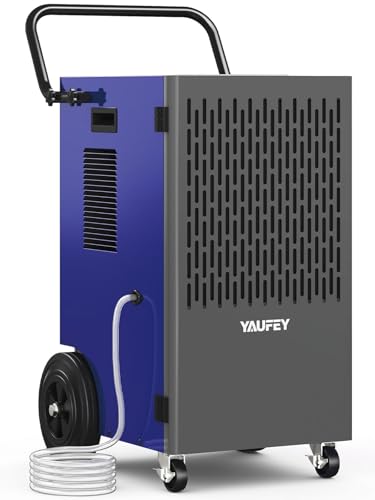 B0CN6ZST2Q
Yaufey 155 Pint Commercial Dehumidifier With Pump
155-pint class; pump; humidity control. Verify every listed specification and variation on Amazon before ordering.
Check on Amazon B0D1R9C6B8
Waykar 150 Pint Commercial Dehumidifier With Pump
150-pint class; built-in pump; basement positioning. Verify every listed specification and variation on Amazon before ordering.
Check on Amazon B0DWFD8TN7
ALORAIR 170 PPD LGR Commercial Dehumidifier With Pump
LGR positioning; built-in pump; industrial use. Verify every listed specification and variation on Amazon before ordering.
Check on AmazonFrequently asked questions
Will a dehumidifier work at 50°F?
Some commercial models are designed for that condition, but removal may be far below the warm-air rating. Check the exact performance table and defrost design.
Can a dehumidifier make the room too hot?
It adds sensible heat, and enclosed drying setups can become hot enough to exceed the operating range. Monitor inlet temperature and manage heat without adding uncontrolled moisture.
Is auto defrost enough for an unheated space?
Not automatically. Confirm the documented minimum, capacity at the actual temperature and whether drain components can freeze.
Final verdict
Select for recurring inlet conditions, not the best number on the box. Verify capacity near the site’s coldest and hottest periods, understand defrost downtime and protect drainage from freezing. When the target is exceptionally dry or cold, compare technologies rather than forcing a standard refrigerant unit outside its useful range. Review the installation after a representative seasonal extreme. A system commissioned only during mild weather has not yet demonstrated year-round control, and its alarm thresholds, drainage protection or operating schedule may need adjustment before the next season. Preserve that seasonal performance record for future comparison.
Continue the research
AHAM Pints vs Saturation Pints on Dehumidifiers
The same machine can show very different pint numbers because warmer, wetter test air yields more condensate.
Open guide →LGR vs Conventional Refrigerant Dehumidifiers
LGR designs are intended to maintain water removal deeper into a drying job, but exact performance curves matter.
Open guide →Desiccant vs Refrigerant Dehumidifiers
Temperature and target humidity often decide which process is more suitable.
Open guide →How Many Commercial Dehumidifiers Do You Need?
Calculate the moisture load and drying target; dividing square footage by a coverage badge is not enough.
Open guide →Use the commercial sizing calculator or return to the commercial dehumidifier guide.