How Does a Whole-House Dehumidifier Work?
Quick answer: A dedicated refrigeration circuit removes moisture while a blower moves air through connected ductwork.
As an Amazon Associate, we may earn from qualifying purchases.
Compare Yaufey 155 Pint Commercial Dehumidifier With Pump on Amazon
Follow one parcel of humid air
Air enters the dehumidifier through a return path and filter. A blower pushes or pulls it across an evaporator coil containing cold refrigerant. If the coil surface is below the air’s dew point, water vapor changes to liquid and falls into a condensate pan. The now-drier air continues across a condenser coil. Refrigerant has carried heat from the cold coil to this warmer coil, and the compressor and fan also add heat, so discharge air is usually warmer than the air that entered.
That journey explains the machine’s purpose. It changes moisture content, not merely the relative-humidity number displayed on a control. It also explains why a dehumidifier is not an air conditioner: an air conditioner rejects collected heat outdoors, while a dehumidifier normally returns heat to indoor air.
The refrigeration loop makes condensation repeatable
Inside the sealed circuit, refrigerant evaporates at low pressure in the cold coil, absorbing heat. The compressor raises its pressure and temperature. At the condenser, the refrigerant releases heat and becomes liquid. An expansion device then lowers pressure so the cycle can repeat. Homeowners do not service this sealed loop as routine maintenance; a refrigeration fault calls for qualified diagnosis.
Coil temperature and entering conditions determine collection. Warm, very humid air can yield more water than cool air at moderate humidity. As the home dries, daily condensate usually falls. Ice or frequent defrost may signal cool conditions, poor airflow, a dirty filter, or a fault, depending on the unit’s documented operating range.
The control reacts to a percentage that moves with temperature
A humidistat compares sensed relative humidity with the selected target. It starts a call when humidity rises beyond the control’s differential and ends the call after conditions fall sufficiently. The differential prevents rapid on-off cycling around one displayed number. Some systems use a sensor in the cabinet; others accept a remote wall control.
Relative humidity is temperature-dependent. Cooler basement air can show a higher percentage than warmer upstairs air with similar absolute moisture. A sensor next to a dry-air grille may satisfy prematurely, while one near a shower or exterior door can call too often. Independent hygrometers in representative locations reveal whether the control reading reflects the house.
Duct design decides whose air reaches the coil
A fully dedicated arrangement has its own return grille and supply grille. It can circulate air without depending on the HVAC blower, provided the grilles and room pathways serve the target area. Other designs draw from or discharge into central return and supply ducts. Those arrangements can use existing distribution, but pressures and blower sequences must be coordinated.
If dry discharge immediately returns to the intake, the machine treats the same air repeatedly. If a zone damper closes, airflow can fall. Long compressed flex duct, small grilles, abrupt fittings, and dirty filters add resistance. The refrigeration cycle may be healthy while remote rooms stay humid simply because their air never reaches it.
Water leaves through a separate system
Condensate moves from the pan into a gravity line or pump. Gravity needs continuous downward slope to a suitable receptor and any trap or vent required by the manual. A pump stores a small amount, then lifts it through tubing when its switch is triggered. Pumps solve elevation but add power dependence, cleaning, lift limits, and a possible overflow point.
Drainage protection should match the location. Equipment above finished space may warrant a secondary pan, alarm, or shutdown control. A machine can remove moisture perfectly and still damage a ceiling if its drain is poorly designed. Observing a complete condensate cycle is therefore part of commissioning, not a minor plumbing detail.
The dehumidifier and air conditioner solve different loads
Cooling systems remove both heat and some moisture while operating. During hot weather, that may be enough. During mild rainy weather, little sensible cooling is needed, so the thermostat can stop the air conditioner before indoor moisture is controlled. A dedicated dehumidifier can run in that gap. Depending on the duct design, its control may also start the central blower.
Some systems introduce measured outdoor air. Ventilation improves indoor-air management but can add substantial moisture when outdoor dew point is high. The designer must include that load and define damper timing, filtration, and extreme-weather behavior. Bringing in outdoor air is not equivalent to dehumidifying it.
What a normal operating cycle should look like
On a humidity call, the appropriate blower starts, airflow is established, and the compressor operates after any built-in delay. Condensate appears only when entering air and coil conditions cross the dew point; it may take time to reach a distant drain. The unit stops when the control is satisfied or enters its designed defrost or protection mode.
To evaluate performance, record return humidity and temperature, supply conditions, runtime, drainage, and readings in distant rooms. Check the filter and visible drain before assuming refrigerant trouble. Also examine sources such as open crawl vents, leaks, and unexhausted showers. The machine repeats a straightforward physical cycle, but the house controls how much wet air arrives and where the dry air goes.
Products to compare for this decision
The products below are exact Amazon catalog records selected for this topic. We have not hands-on tested every machine. Confirm the current variation, seller, capacity conditions, electrical requirements, drainage configuration, warranty and availability before buying.
As an Amazon Associate, we may earn from qualifying purchases.
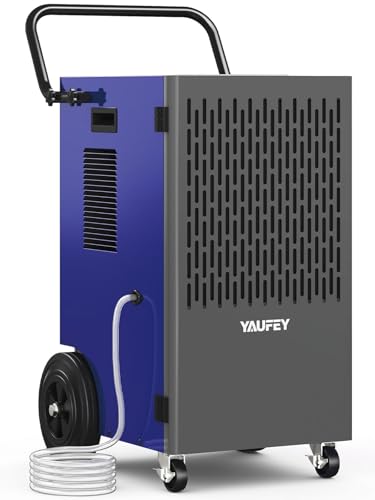 B0CN6ZST2Q
Yaufey 155 Pint Commercial Dehumidifier With Pump
155-pint class; pump; humidity control. Verify every listed specification and variation on Amazon before ordering.
Check on Amazon B0GVZPZJ6R
Marshal WD160 Whole-House Dehumidifier
whole-house positioning; fresh-air function; remote controller. Verify every listed specification and variation on Amazon before ordering.
Check on Amazon B0FN8B5KV3
AEOCKY 6000-Square-Foot Commercial Dehumidifier
large-space listing; Energy Star claim; verify installation fit. Verify every listed specification and variation on Amazon before ordering.
Check on AmazonFrequently asked questions
Why does the discharge feel warm?
The condenser returns absorbed heat plus compressor and fan heat to the airstream, so drier outlet air is normally somewhat warmer.
Why is no water coming from the drain?
The space may already be dry, conditions may be cool, the compressor may not be operating, airflow may be restricted, or drainage may be blocked; diagnosis requires checking the full cycle.
Can it operate while the air conditioner is off?
Many systems can, especially with dedicated ducts, but the approved duct layout and control sequence determine whether another blower is required.
Final verdict
A whole-house dehumidifier works through four linked systems: refrigeration condenses vapor, a blower carries air, a control decides when to operate, and a drain removes water. Weakness in any one of those systems can make a sound cabinet appear ineffective.
Continue the research
Who Installs Crawl-Space Dehumidifiers?
The right contractor depends on whether the project needs moisture diagnosis, encapsulation, drainage, electrical work, HVAC ducting or all five.
Open guide →What Size Dehumidifier Does a Crawl Space Need?
Size from volume and moisture load, then check capacity at the crawl space’s temperature—not at a warmer marketing condition.
Open guide →How Does a Crawl-Space Dehumidifier Work?
The unit draws moist air across a cold coil, collects condensate and returns drier, slightly warmer air to the enclosed space.
Open guide →Crawl-Space Dehumidifiers for 2,000 Square Feet
Coverage labels are a shortlist tool; temperature, height, leakage and water entry determine whether the capacity is credible.
Open guide →Use the commercial sizing calculator or return to the commercial dehumidifier guide.