Whole-House Dehumidifier Pros and Cons
Quick answer: Central humidity control can improve consistency and drainage, but installation complexity and service cost exceed a portable unit.
As an Amazon Associate, we may earn from qualifying purchases.
Compare AEOCKY 8000-Square-Foot Commercial Dehumidifier on Amazon
The case for central humidity control
The strongest argument for a whole-house dehumidifier is consistency. A correctly designed system can draw air from a broad portion of the home, remove water automatically, and deliver drier air without buckets occupying living space. This is especially useful during warm, damp weather when the thermostat is satisfied quickly and the air conditioner does not run long enough to handle the latent load. People may feel comfortable at a less aggressive cooling setting when indoor moisture is controlled, although energy savings should never be promised.
Central equipment can also simplify routine ownership compared with running several portable units. There may be one filter schedule, one drain, and one control. The cabinet can be placed outside primary living areas, reducing visible clutter. These advantages depend on access: hiding a unit in an attic or tight crawl space may make every filter change harder and every water failure more consequential.
Better distribution is possible, not automatic
A ducted system has the potential to influence multiple rooms, but air does not spread evenly merely because the product is labeled whole-house. Closed bedroom doors, multiple floors, isolated additions, restrictive ducts, and HVAC zone dampers can leave remote areas untreated. A dedicated return and supply can create a predictable loop; connections to central ducts can use existing distribution but introduce blower and pressure interactions.
This distinction belongs on both sides of the ledger. When the air path is engineered well, one central machine can outperform a collection of noisy room units. When the path is improvised, the controller near the cabinet may reach its target while an upstairs closet stays damp. Before valuing the convenience of one system, ask where it draws from, where it supplies, and what happens when the air handler is off or a zone is closed.
What the system can protect—and what it cannot repair
Stable humidity can reduce condensation risk and create less favorable conditions for musty odors and future biological growth. It may help protect stored paper, textiles, wood finishes, and other moisture-sensitive materials. A system that continues operating during low cooling demand can address a seasonal gap left by air conditioning.
None of this makes the equipment remediation. It does not remove existing mold, sanitize contaminated material, stop groundwater, seal a roof, repair plumbing, or correct sewer gas. If a wet foundation or open crawl vent continually adds moisture, the dehumidifier pays an energy penalty while the source remains. Source investigation is therefore not a separate optional project; it determines whether the apparent benefit will be durable.
The less visible disadvantages
Purchase cost is only the beginning. Duct fabrication, controls, electrical work, drainage, permits, ceiling access, and commissioning can exceed the price of the cabinet. The refrigeration system consumes electricity and rejects heat indoors. That heat may be inconsequential in a cool basement but undesirable when delivered into occupied space. Blower sound can travel through grilles or framing even when the cabinet itself is remote.
Maintenance includes filters, drain inspection, pump testing where applicable, and eventual refrigeration or control service. A clogged gravity line or failed pump can leak. An inaccessible installation increases labor cost and encourages neglect. Replacement can also be more disruptive than swapping a portable appliance because the new cabinet must fit existing ducts and controls.
Portable dehumidifiers remain the better answer sometimes
A portable unit is compelling when high humidity is confined to one accessible room, the need is temporary, the property is rented, or duct alteration is unreasonable. Initial cost is lower, replacement is simple, and the unit can be moved to confirm whether drying changes comfort or odor. Its disadvantages are visible noise, floor space, bucket handling or exposed hoses, and limited reach.
Compare complete scenarios rather than equipment prices. Three portable units have three fans, filters, drains, and controls. One central unit has installation expense and a single point of failure. A homeowner with one damp basement may reasonably choose targeted equipment; a home with persistent readings on several floors may justify central distribution. Neither category wins without the measurements.
A balanced decision worksheet
List the rooms that exceed the desired humidity range, when the problem occurs, and whether doors are normally closed. Record independent readings during humid weather. Then list known sources: showers, cooking, outdoor-air leakage, basement seepage, crawl-space vapor, ventilation, and duct leakage. Mark which sources can be corrected before buying equipment.
For each option, compare installed cost, drainage reliability, noise at occupied rooms, access for filters, annual electricity scenarios, service availability, and the likelihood that air will reach the problem areas. Request a model-specific duct sketch for a central proposal. If the contractor cannot explain sensing and distribution, the convenience claim has not been demonstrated.
Who is most likely to benefit
The strongest candidate has broadly elevated readings, limited air-conditioner runtime during humid weather, corrected bulk-water problems, an accessible installation location, a safe drain, and a practical air path. The weakest candidate has one localized wet spot, an active leak, no drain strategy, or an expectation that the machine will clean existing contamination.
Success should be judged after installation with readings in multiple locations, normal door positions, and representative weather. If remote rooms do not respond, investigate distribution, sensor placement, and outdoor-air entry before lowering the setpoint. Excessive dryness and nonstop operation are not signs of extra protection; they can indicate poor setup or an unrealistic target.
Products to compare for this decision
The products below are exact Amazon catalog records selected for this topic. We have not hands-on tested every machine. Confirm the current variation, seller, capacity conditions, electrical requirements, drainage configuration, warranty and availability before buying.
As an Amazon Associate, we may earn from qualifying purchases.
 B0FWB57KYQ
AEOCKY 8000-Square-Foot Commercial Dehumidifier
large-space listing; Energy Star claim; verify rated condition. Verify every listed specification and variation on Amazon before ordering.
Check on Amazon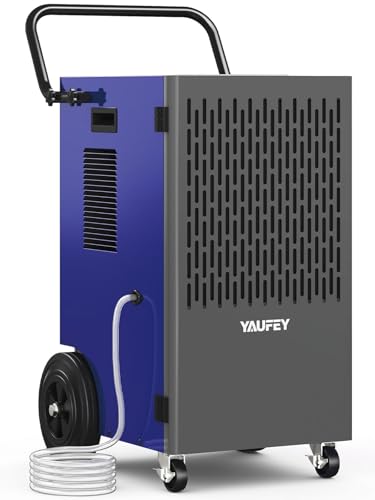 B0CN6ZST2Q
Yaufey 155 Pint Commercial Dehumidifier With Pump
155-pint class; pump; humidity control. Verify every listed specification and variation on Amazon before ordering.
Check on Amazon B0GVZPZJ6R
Marshal WD160 Whole-House Dehumidifier
whole-house positioning; fresh-air function; remote controller. Verify every listed specification and variation on Amazon before ordering.
Check on AmazonFrequently asked questions
Will a whole-house dehumidifier replace air conditioning?
No. It primarily removes moisture and normally releases slightly warmer air; cooling equipment handles sensible heat.
Is one system quieter than several portable units?
Often in occupied rooms, but duct-borne sound, grille velocity, cabinet placement, and framing vibration determine the actual result.
Does central dehumidification prevent mold?
It can reduce humidity that supports future growth, but it does not remove existing mold or correct water intrusion.
Final verdict
Whole-house dehumidification offers unattended control and broad distribution when the home truly has a broad moisture problem. Its disadvantages—installation cost, system complexity, heat, service access, and drainage risk—are justified only when measurements and a credible airflow design show that targeted solutions are insufficient.
Continue the research
How to Install a Crawl-Space Dehumidifier: Planning Before the Work
A safe plan follows the exact manual and local requirements rather than a universal set of internet measurements.
Open guide →Who Installs Crawl-Space Dehumidifiers?
The right contractor depends on whether the project needs moisture diagnosis, encapsulation, drainage, electrical work, HVAC ducting or all five.
Open guide →What Size Dehumidifier Does a Crawl Space Need?
Size from volume and moisture load, then check capacity at the crawl space’s temperature—not at a warmer marketing condition.
Open guide →How Does a Crawl-Space Dehumidifier Work?
The unit draws moist air across a cold coil, collects condensate and returns drier, slightly warmer air to the enclosed space.
Open guide →Use the commercial sizing calculator or return to the commercial dehumidifier guide.